Corporate alumni networks: how to manage your former employees
7 min read

Written by Borja MartosCMO & Co-Founder
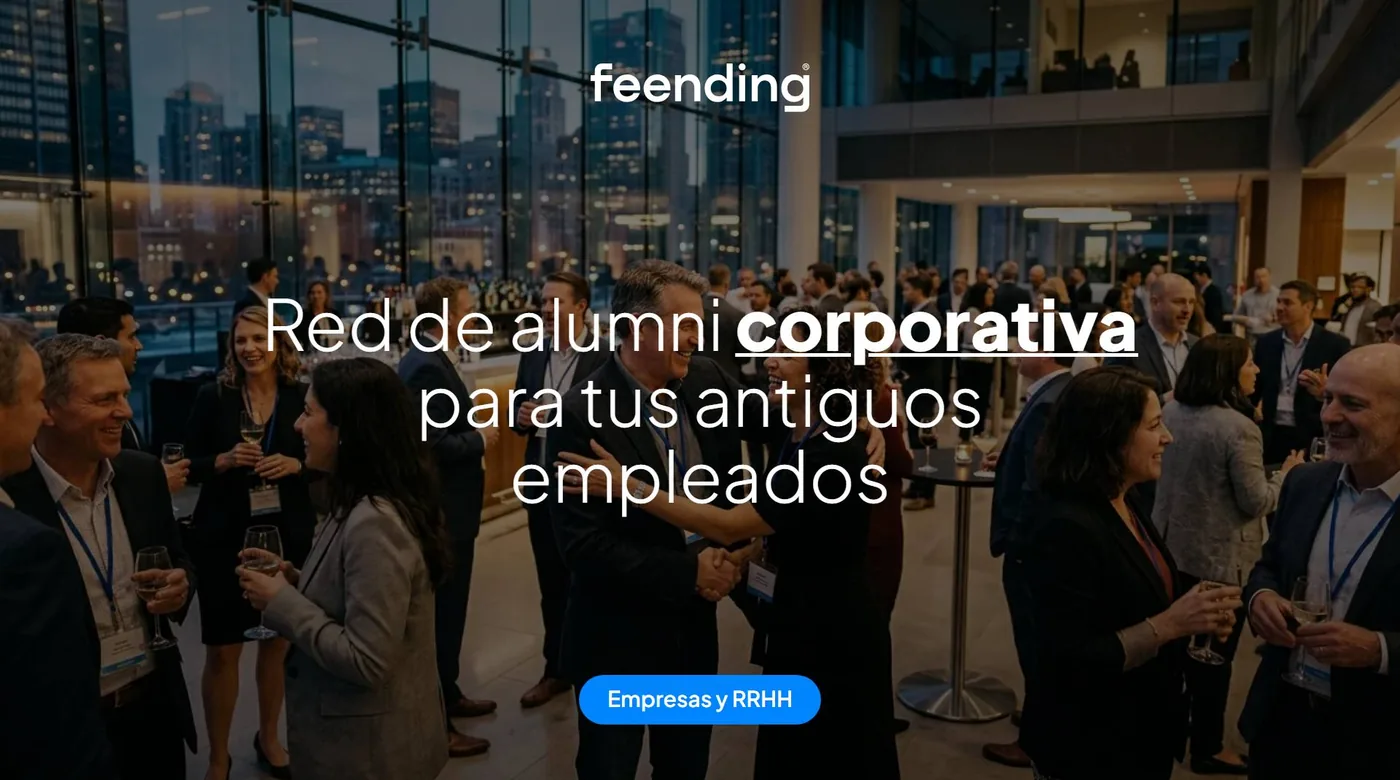
A corporate alumni network is the community a company keeps with its former employees so the relationship continues after they leave. Managed well, it brings back talent that already knows the business (boomerang employees), generates candidate referrals, opens doors to new clients and partners, and strengthens the employer brand.
Every year, trained people with good contacts and a good opinion of your company walk out the door. Most of them end up as a closed record in an HR system. This guide explains what a corporate alumni network is, what companies gain from it, what role AI and analytics play in modern corporate alumni management, and how to set one up in five steps.
What is a corporate alumni network?
It is a private community of people who have worked at a company, kept active on purpose by the organization. It is not a list of leavers or an unmoderated LinkedIn group: it is a space with identified members, its own communication, events and opportunities designed for them.
It resembles a university alumni network, but the goal is different. A university looks for loyalty, mentoring and donations; a company looks for talent, business and reputation. If you manage a graduate community instead, read what an alumni network is and how to build one.
Why do companies invest in their former employees?
Because a former employee knows your culture, your processes and your clients, and that knowledge is valuable outside your payroll. The value shows up in four areas.
1/ Boomerang employees. These are people who return after a period elsewhere. They bring new experience, ramp up faster and carry less hiring risk, because you already know how they work. For them to come back, they need to keep hearing from you.
2/ Candidate referrals. A former employee knows which profile fits your team and, if the relationship is alive, recommends people.
3/ New clients and partners. Many alumni end up at clients, suppliers, investors or industry peers.
4/ Employer brand. What former staff say about you carries as much weight as what current staff say. A well-handled departure turns into a recommendation.
Which companies run corporate alumni programs?
Consulting firms were the first to treat former employees as a strategic network, and the model has since spread to technology and other sectors. Three public examples:
McKinsey & Company. It runs an alumni program with its own section on its website. According to that page, its alumni number more than 34,000 and work at over 15,000 organizations in more than 120 countries.
Deloitte. Each member firm runs its own alumni network. Deloitte Canada's uses the tagline "Colleagues. Friends. Mentors. For life." and offers an online directory, events, access to the firm's insights, a job board and the option to return.
Microsoft. The Microsoft Alumni Network is a member organization for former employees which, according to its website, spans a community of more than 290,000 people in 128 countries.
The pattern repeats: directory, events, content, jobs and an open door to return. What changes is scale, and how well the network connects people with each other. This applies equally to alumni management for financial services, law firms or industrial groups.
What is the role of AI and analytics in modern corporate alumni management?
AI and analytics turn a database of former employees into a network that runs on its own: they keep profiles up to date, spot who fits a vacancy or a business opportunity, suggest relevant connections between alumni and current staff, and measure which actions lead to rehires, referrals or revenue.
These are three jobs nobody can do by hand once the network passes a few hundred people.
1/ Profiling. AI builds and updates each former employee's profile from what they share, their career path and their activity on the platform. Without living profiles, the network is just a list of old email addresses.
2/ Connecting. With those profiles, the system suggests who should meet: an alumnus who could return for a specific role, a former manager who now buys in your sector, a mentor for a new hire. We explain it in how smart networking works in professional communities.
3/ Measuring. Analytics shows who takes part, which segments respond and which activity ends in a rehire, a referral or a sale. HR can then back the program with data rather than gut feeling. For more on AI in this kind of network, see AI for alumni management.
How do you set up a corporate alumni network in 5 steps?
Start with the goal and leave the tool for last.
1/ Decide what it is for. Rehiring, referrals, business development, employer brand, or all of them. The goal decides what data you ask for, what content you publish and what you measure.
2/ Build it into offboarding. The invitation to join should be part of the exit process, with clear consent to handle personal data.
3/ Choose a private platform. A group on an open network gives you no data of your own, no segmentation and no control over the experience. You need a branded space where directory, communication, events and jobs live together. Whether you buy a corporate alumni management solution or use managed services around it, compare options with our guide to the best alumni management software.
4/ Give people a reason to come back. Exclusive job openings, meetups, industry content, mentoring with current staff. The Lo Que De Verdad Importa Foundation, for example, grew sign-ups by 42% and improved how it runs events and mentoring after centralizing its community, as its success story shows.
5/ Name an owner and measure from day one. A network without an owner fades; someone in HR or employer branding must have it on their agenda, with clear indicators.
Which metrics should a corporate alumni program track?
The ones that tie the network to business goals, not just to activity.
Reach: share of former employees who join and keep their contact details current.
Engagement: monthly active members, event attendance, response to communications.
Talent: number of boomerang rehires and candidates referred by alumni.
Business: deals and partnerships that originate in the network.
Brand: how alumni rate their relationship with the company over time.
To build the full dashboard, see how to measure the impact of a professional community.
How does Feending help manage a former employee network?
Feending BUSINESS is a private, one-of-a-kind platform for your company's alumni network, with a web and app under your brand. It works for the HR team and for the former employee.
The team has the alumni database, communication (chat, email and news feed), events, resources and jobs in a single dashboard. Former employees get a personalized experience: an AI builds their profile and suggests who to meet across five dynamics (networking, mentoring, sales, investment and hiring), which map closely onto what a company wants from its alumni. See it on Feending for companies.
Frequently asked questions
What is corporate alumni management?
It is the work of keeping former employees connected to the company through a private network: maintaining their data, communicating with them, running events and opportunities, and measuring what the network brings in talent, business and reputation.
What is a boomerang employee?
It is someone who returns to work at a company after leaving it. They usually ramp up faster and bring experience gained elsewhere, which is why many companies use their alumni network to stay in touch.
What role does AI play in modern corporate alumni management software?
It keeps former employees' profiles up to date, suggests relevant connections and opportunities for each one, and measures which actions lead to rehires, referrals or business, something impossible by hand when the network has hundreds or thousands of people.
How is a corporate alumni network different from a university one?
A university network brings together graduates and seeks loyalty, mentoring and support for the institution. A corporate network brings together former employees and seeks talent, business and employer brand. The technology can be the same; the goals and metrics differ.
Turn your former employees into an active network
If you want the people who worked with you to keep adding value, Feending is the private, one-of-a-kind platform for your alumni network. Request a free demo.