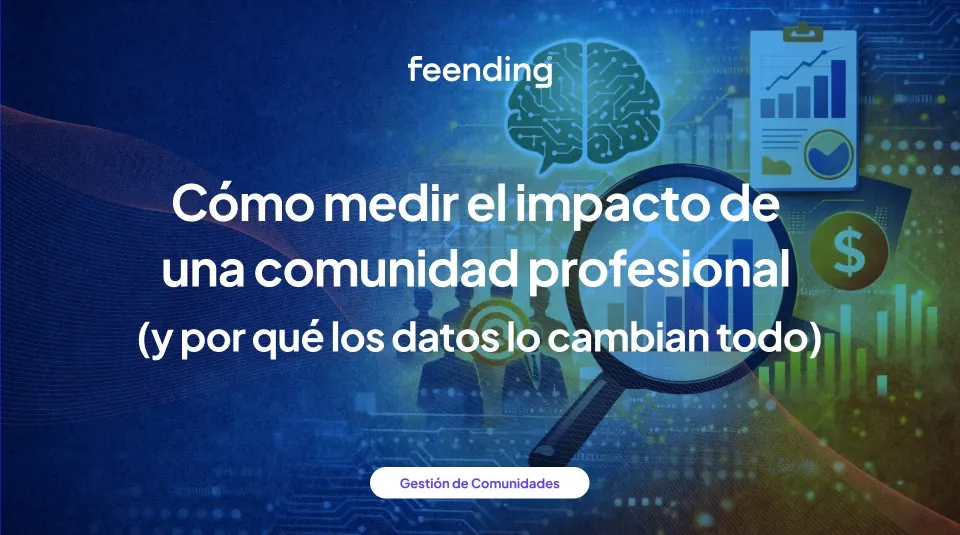
How to measure the impact of a professional community (and why data changes everything)
2 min read
For a long time, professional communities have been managed based on intuition. Feelings, perceptions, impressions after an event or a specific action. "It seems to have gone well," "people were happy," "there was a good atmosphere."
And while all that is important, it is not enough when a community wants to grow, improve its value proposition, and be sustainable over time.
👉 Before talking about data, it is important to understand what it really means to manage a professional community effectively and purposefully.
The big problem: communities without data
Many professional communities continue to operate without real data. Not because they don't want to measure, but because they do not have the tools to do so.
When a community does not measure:
They do not know who is genuinely participating
They do not understand what types of activities generate the most value
They do not know the real interests of their members
They cannot improve their value proposition
They cannot demonstrate impact to sponsors or stakeholders
Managing a community without data is like doing it blindly.
What types of data matter in a professional community
When we talk about data, we are not talking about numbers just for the sake of having them. We are talking about useful data, data that helps make decisions and better understand the people who are part of the community.
Participation data
Who participates and who does not
What actions generate the most activity
How engagement evolves over time
Connection data
What profiles interact with each other
What interests are repeated
What connections have continuity
Behavior data
What content is consumed the most
What dynamics work best
What formats generate the most value
This data truly allows you to know the community, not just its size.
Data as a tool to improve the value proposition
A professional community improves when it understands what adds value to its members. And that is not guessed; it is measured.
With real data, you can:
adjust events and content
personalize experiences
eliminate actions that do not work
reinforce what does generate impact
This turns community management into a process of continuous improvement.
Beyond events: data for the entire community
Although events are one of the most visible moments of a community, the real impact goes much further.
Data allows you to understand:
how members interact between events
what relationships are maintained over time
which profiles generate more value within the ecosystem
👉 This is one of the big problems of managing communities without a system, as happens when generic tools like WhatsApp are used.
That's why we explain why managing communities with WhatsApp ends up being a problem.
Data and profitability: when the impact can be demonstrated
One of the major challenges for professional communities is sustainability. And here, data plays a key role.
When a community can demonstrate:
real participation
relevant connections
measurable impact
then it can:
justify a subscription
attract aligned sponsors
build a sustainable model
Profitability stops being a promise and becomes a consequence of demonstrated value.
The role of artificial intelligence in measuring impact
This is where technology makes a difference.
Platforms like Feending, a community management platform with artificial intelligence, allow you to transform a community's daily activity into actionable data, without additional manual work.
Thanks to its artificial intelligence, Feending:
generates automatic reports
detects behavioral patterns
analyzes connections and affinities
helps understand what is happening within the community
This allows you to move from raw data to real insights for decision-making.
Real example: when data changes the way a community is managed
Communities like Impact Social Cup have been able to better understand how their participants relate, what kind of connections are generated, and how the community evolves over time by centralizing all their activities on a platform that measures and analyzes these interactions.
Instead of relying on feelings after each event, they can observe real data on participation, connections, and continuity, which allows them to improve future editions and reinforce the value of their proposition.
From intuition to intelligence
Measuring the impact of a professional community does not mean dehumanizing it. On the contrary: it allows for a better understanding of people, designing more relevant experiences, and better caring for the community.
When management is supported by data, the team's effort multiplies and the value generated is much clearer for all involved.
Conclusion
Professional communities that do not measure their impact rely on intuition and the constant effort of a few people. Those that do, build sustainable ecosystems, improve their value proposition, and make decisions with criteria.
Today, measuring the impact of a professional community is possible thanks to technology and artificial intelligence. And when data becomes knowledge, the community stops being just a group of people and transforms into a strategic asset, alive and in constant evolution.
![Association management software: what it should have [2026]](/assets/software-gestion-asociaciones-DujLQosD.webp)