The 5 most common mistakes when managing a professional community
4 min read

Written by Borja MartosCMO & Co-Founder
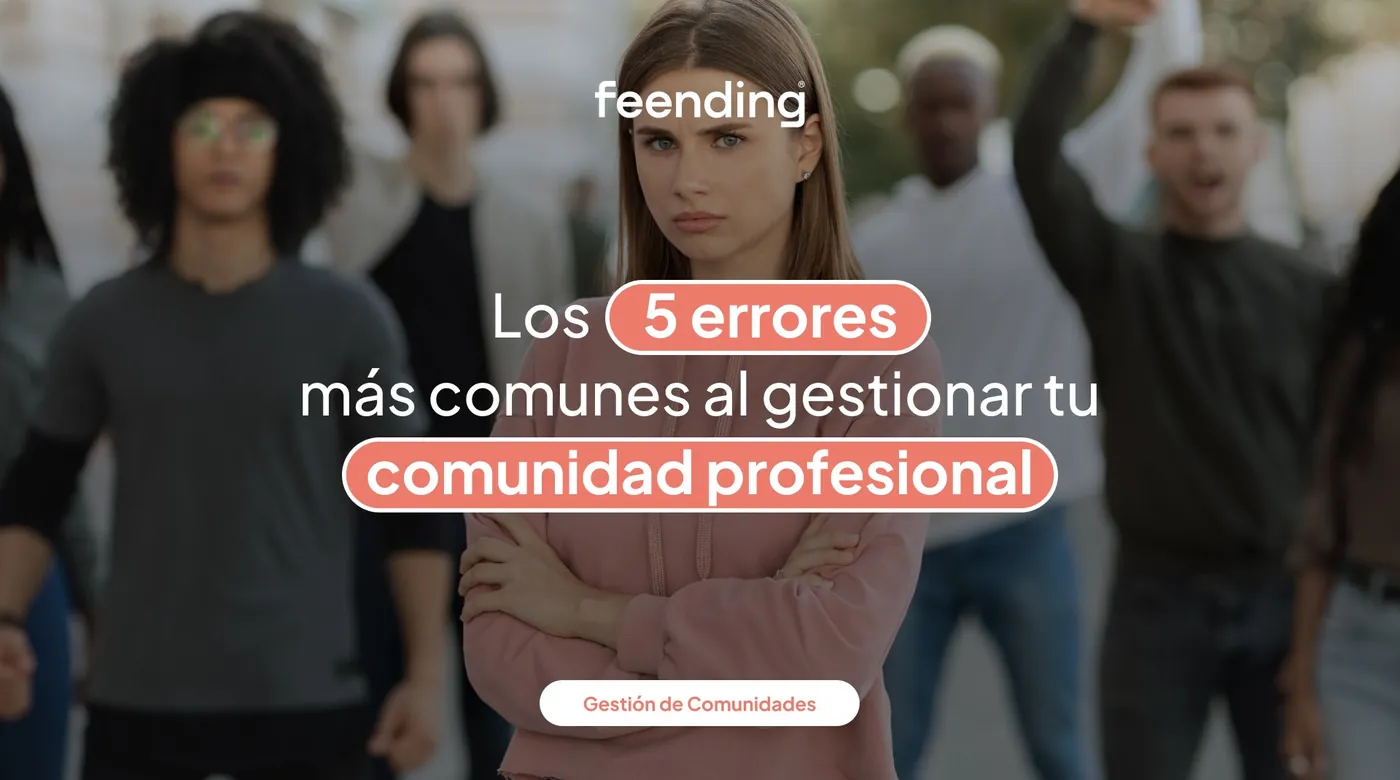
Managing a professional community may seem simple from the outside. Gathering people with common interests, creating a group, organizing a specific event, and maintaining some active communication. However, many communities do not fail due to a lack of interest or talent, but rather due to structural errors that are repeated over and over again.
The problem is usually not the intention.
The problem is the lack of a system.
When the community grows, small errors become significant brakes. And if not corrected in time, the impact fades.
Error 1: Confusing communication with management
One of the most common mistakes is thinking that managing a community is simply communicating with it.
Sending messages, publishing news, or reminding about events is not management. That is communication.
Management entails:
designing a structure
defining participation dynamics
facilitating relationships among members
measuring what happens
👉 We develop this error in depth in how to manage a professional community effectively and purposefully.
A community can have a lot of communication and still be poorly managed. The difference lies in whether there is a system behind that supports the activity.
Error 2: Not defining a clear purpose
Communities that work have a very defined “why”.
When that purpose does not exist or is not well communicated:
participation is irregular
members do not know how to contribute
dynamics lose meaning
The purpose is what aligns expectations and generates belonging. Without a purpose, the community becomes just another channel for information, not a space for shared value.
Error 3: Depending on a single person
This is one of the most invisible and dangerous mistakes.
When everything goes through one person:
management depends on their time and energy
knowledge is not distributed
the community becomes fragile
If that person gets tired, changes roles, or leaves the organization, the community suffers.
Strong communities do not depend on heroes; they depend on systems.
Error 4: Using tools not designed for communities
Tools like WhatsApp, Excel, or generic email platforms can work in an initial phase. The problem arises when the community grows and continues to be managed the same way.
At that moment, the following arise:
dispersed information
duplication of processes
difficulty measuring impact
operational chaos
👉 That’s why we explain in detail why managing communities with WhatsApp becomes a problem.
It is not that those tools are bad, but that they are not designed to manage professional communities as a system.
Error 5: Not measuring what happens inside
Without data, there is no improvement.
Many organizations cannot clearly answer basic questions:
Who actually participates?
Which activities generate the most value?
What type of connections are being made?
Without that information, management is based on instincts. And intuition does not scale.
👉 This point is key, and we develop it in how to measure the impact of a professional community (and why data changes everything).
Measuring is not bureaucratizing. It is learning.
Learning from mistakes
These mistakes do not mean that a community is poorly planned. On the contrary, they often appear when the community begins to grow and management does not evolve with it.
It is a sign of maturity.
Just as years ago sales teams had to digitalize with CRM to grow in an orderly and controlled manner, today professional communities are experiencing that same moment.
Conclusion
Managing a professional community requires intention, structure, and continuous learning. Avoiding these mistakes does not guarantee success, but repeating them almost assures stagnation.
When an organization decides to professionalize management and rely on software specifically designed for professional communities, it stops improvising and starts working systematically.
In this context, platforms like Feending allow for centralizing members, communication, events, and data in a single environment designed to scale communities with purpose. It is not just about digitalizing for efficiency but about transforming the community into a strategic, measurable, and sustainable asset.
Communities do not fail due to a lack of talent.
They fail when they do not have the appropriate structure to grow.
And that is precisely the moment when making the leap to professional management makes the difference.