The Alumni communities have ceased to be an informal space for former students. Today, they are a strategic asset for universities and educational centers that want to strengthen their brand, create professional opportunities, and build lasting relationships with their ecosystem.
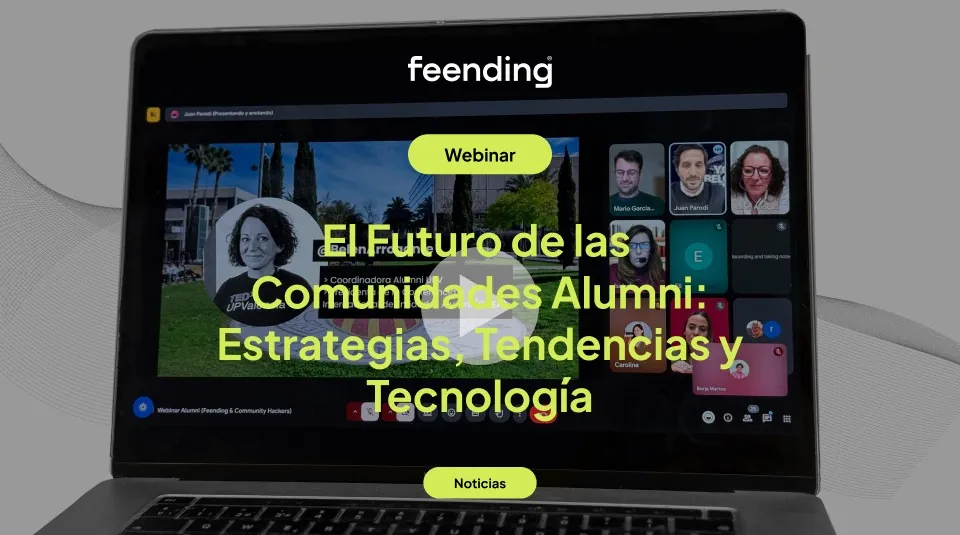
This vision was the central axis of the webinar “The Future of Alumni Communities”, organized by Feending and Community Hackers, which brought together over a hundred professionals from the educational, university, and associative fields to reflect on how these communities are evolving and what strategic decisions are necessary for them to remain relevant.
🎥 (Here you can embed the webinar video)
👉 https://www.youtube.com/watch?v=pYwSv3mjNMo
From alumni to strategic asset
For years, many Alumni communities have been managed as an “extra”: mailing lists, occasional communications, and sporadic meetings. The problem with this approach is that the relationship cools over time and the community's potential is lost.
Today, Alumni communities:
influence institutional reputation
generate professional opportunities
strengthen the sense of belonging
impact the recruitment of new students
👉 This paradigm shift directly connects with the return of a well-managed community, as we explain in the return of a well-managed professional community.
The experience of Alumni UPV: growth requires professionalization
One of the key moments of the webinar was the intervention of Belén Arrogante, Coordinator of Alumni UPV at the Universitat Politècnica de València (UPV) and President of the International Conference of Alumni Entities (CIEEA).
Belén shared the evolution of the Alumni UPV community, which has grown from 12,000 to over 80,000 members, and highlighted the growth of the Alumni UPV Plus program, which already exceeds 7,200 members.
This growth presented a clear challenge: without professionalizing management and relying on data, a community of this size cannot sustain or evolve.
Technology, strategy, and community: Feending's approach
During the webinar, Mario García-Granero, CEO of Feending, explained how technology plays a key role in scaling Alumni communities without losing the human focus.
His message was clear:
the community is built from the people, but it becomes sustainable through systems that allow knowing, anticipating, and supporting each member.
Feending enables:
centralize the management of the Alumni community
automate operational processes
generate participation and impact data
offer personalized experiences supported by artificial intelligence
“Technology should know each Alumni as if they were a friend: anticipate what they need, recommend who to connect with, and what opportunities they cannot miss.”
This approach connects with a key idea: digitalization does not replace the relationship, it amplifies it.
👉 This approach of flexible and evolutionary technology we developed in for what type of organizations makes sense to have a professional community management platform.
Five keys for the Alumni communities of the future
As a closing of the webinar, the speakers summarized five strategic learnings that define the future of Alumni communities:
1. Integrate the Alumni stage into the student experience
The relationship does not start after graduation; it starts before.
2. Design segmented value propositions
Each professional stage needs a different type of relationship.
3. Build memorable and human experiences
It is not about communicating more, but about creating relevant moments.
4. Invest in data, measurement, and artificial intelligence
Without data, there is no strategy or possible evolution.
5. Start with a minimum viable community
Validate, learn, and scale coherently.
👉 This approach connects with the idea of moving from informal communities to professional ones, as we analyze in how to move from an informal community to a well-managed professional community.
Alumni as a differentiation and attraction factor
The webinar concluded with a key reflection:
universities with strong Alumni communities will be more attractive to future students, more relevant to the labor market, and better able to generate social and professional impact.
More and more, the Alumni community stops being a secondary service to become:
a differentiation element
a reputation lever
a new strategic line
👉 The impact on branding and experience we develop in how digitizing your community enhances brand value and member experience.
Conclusion
The future of Alumni communities lies in their professionalization, digitalization, and ability to generate real value over time. Webinars like this demonstrate that the challenge is no longer conceptual, but strategic.
Relying on platforms like Feending allows universities and educational centers to make the leap from intuition to data, from communication to management, and from memory to a vibrant and sustainable community.
Want to know more? 👉🏼 CONTACT US!
![Association management software: what it should have [2026]](/assets/software-gestion-asociaciones-DujLQosD.webp)