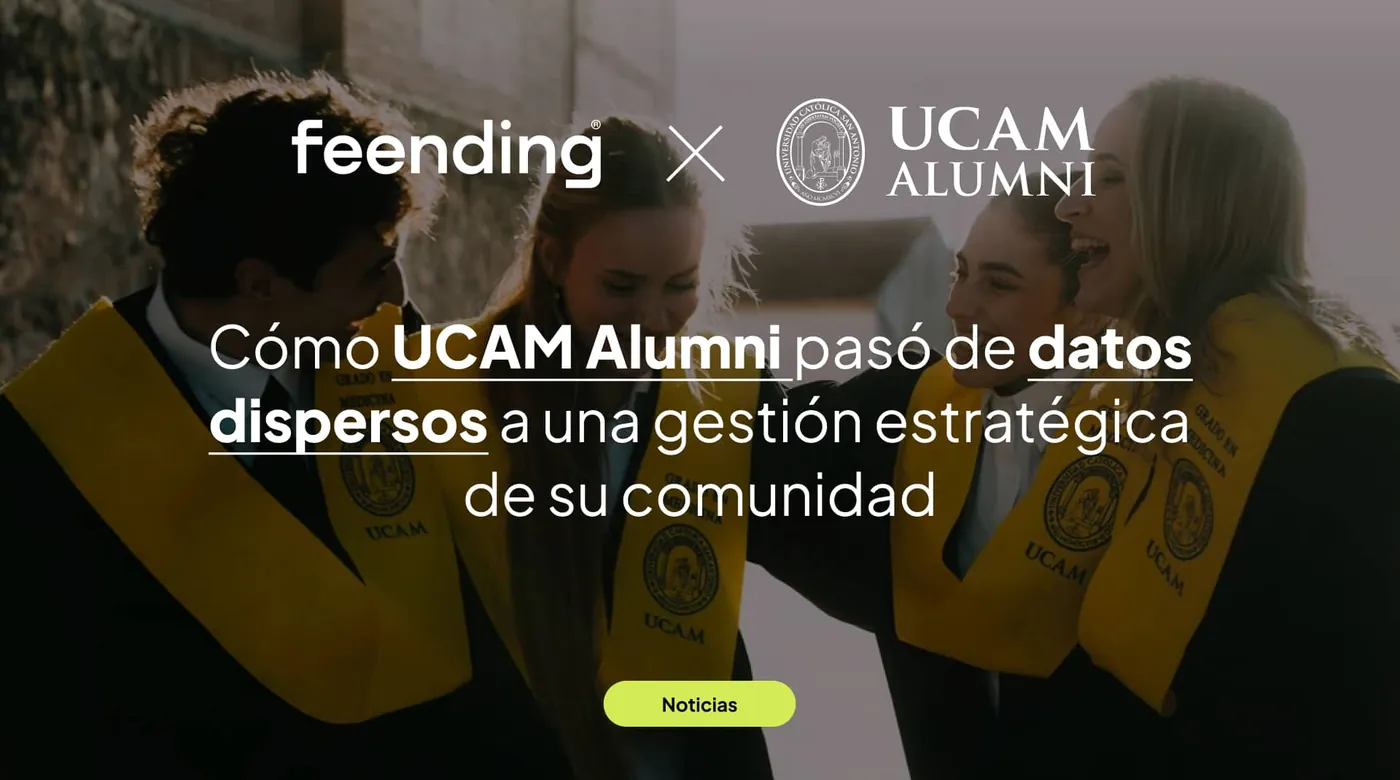
How UCAM Alumni went from scattered data to strategic management of its community
3 min read

Written by Borja MartosCMO & Co-Founder
👉 You can view the full case in this LINK
The starting point: a community without a system
UCAM Alumni had something very valuable: thousands of alumni with connection potential.
But it also had a very common structural problem:
👉 The community existed… but it was not managed as such
The information was scattered across:
Forms
Spreadsheets
Email tools
Disconnected platforms
This generated:
Difficulty segmenting profiles
Lack of visibility into activity
A lot of manual work
Inability to make data-driven decisions
The solution: turning the database into a managed community
The implementation of Feending made something key possible:
👉 Moving from “managing contacts” to “managing a community”
Specifically, UCAM Alumni achieved:
1. Total centralization
All information was brought into a single structured system.
2. Advanced segmentation
Profiles organized by interests, background, and activity.
3. Efficient event management
Greater control, organization, and follow-up.
4. Smarter communication
More relevant and personalized messages.
5. Global view of the community
Real-time updated data.
The impact: from operational to strategic
The change was not only technical, it was conceptual:
x5 in segmentation speed
Elimination of scattered tools
Improved decision-making
Increase in registrations and communication
But most importantly:
👉 The community went from being operational to being strategic
Key learning
What does it mean to manage a professional community?
It means having:
Structured data
Global vision
Ability to activate relationships
This case demonstrates something key for the category:
👉 Without a system, a community does not scale
👉 With a system, it becomes an asset
You can view the full case in this LINK