For a long time, managing a professional community has been an intuitive task. "You did what seemed to work," repeating dynamics that had been effective in the past and relying on the good will and drive of the most involved people.
That model can work in early phases.
But it has a very clear limit.
When the community starts to grow, complexity increases and intuition is no longer enough. Frictions, dependencies, and a constant feeling of putting out fires emerge.
👉 This tipping point occurs when the community stops being informal, as we explain in when a community stops being informal and needs to professionalize.
The problem of relying on people, not on systems
One of the major mistakes in community management is to rely too much on people and too little on systems.
When there is no software or clear structure:
the manager becomes a bottleneck
knowledge is not documented or shared
the community relies on "hero" profiles
growth generates wear and frustration
Everything goes through one person or a small group. They are the ones who organize, connect, communicate, and drive. As long as they have energy, the community moves forward. When they tire, the community stagnates.
This is exactly what happened in sales teams before CRM. Success depended on individual talent, not on the system. And that made it impossible to scale in an orderly manner.
Intuition: useful, but insufficient for growth
Intuition is valuable. It allows you to start, test, and adapt.
But it does not scale.
Without a system that captures what happens within the community:
you do not learn cumulatively
mistakes are repeated
decisions are made without context
activity is confused with impact
As the community grows, the lack of control affects not only management but also the experience of the members themselves.
The role of software in control and scalability
Software does not replace strategy or purpose.
It amplifies them.
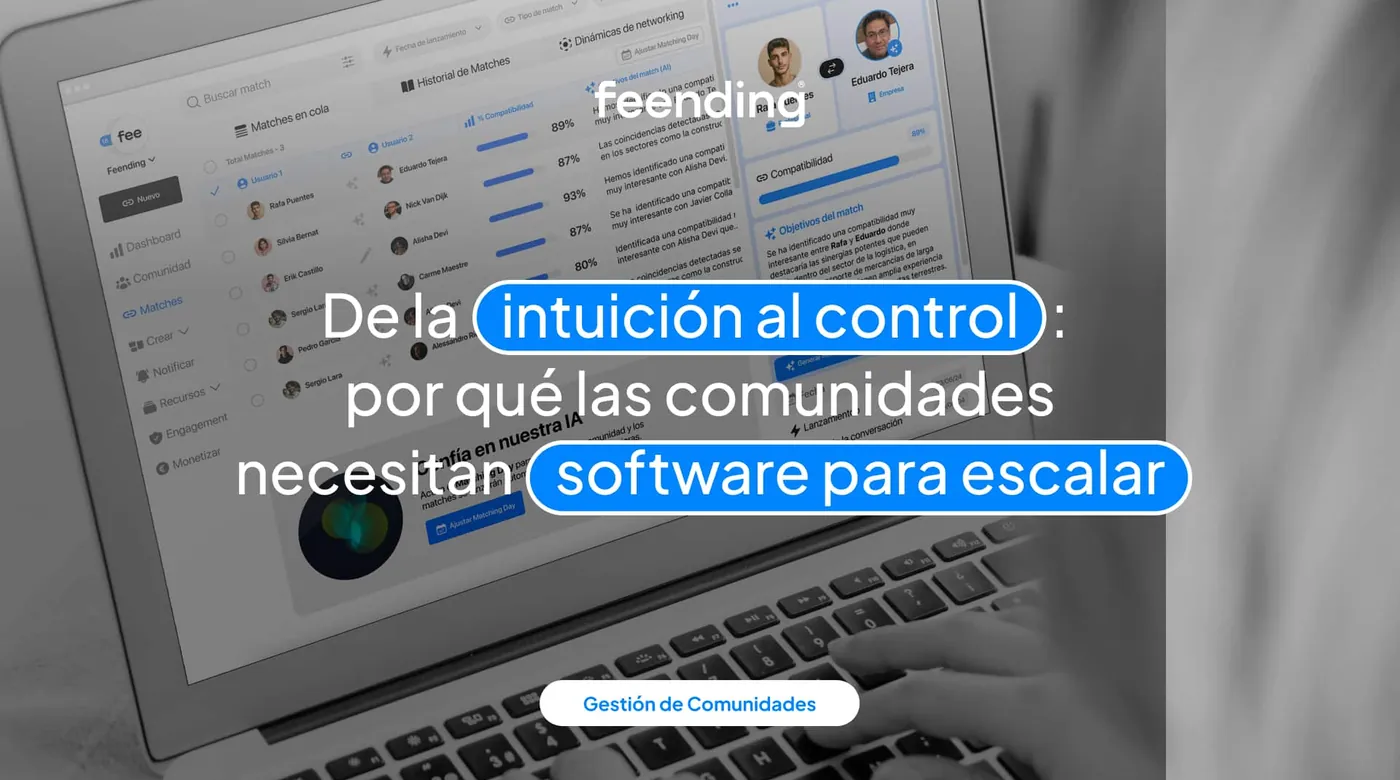
In professional communities, specialized software allows for a shift from reactive management to conscious management. Instead of acting on intuition, one begins to work with information.
Software like Feending allows:
to have a global view of the community
to understand who participates and how
to measure the real impact of activities and events
to design dynamics with intention
to reduce dependence on specific individuals
👉 Without data, there is no improvement, as we develop in how to measure the impact of a professional community (and why data changes everything).
Just as CRM allowed sales teams to know what worked and what didn't, community software enables decision-making based on criteria rather than just feelings.
Control is not rigidity
One of the most common fears when talking about digitalization is the thought that introducing software will make the community cold, bureaucratic, or less human.
The reality is usually the opposite.
Well-understood control:
frees up time
reduces friction
organizes processes
allows focus on people and relationships
When management is clear and centralized, the team stops dedicating energy to repetitive tasks and can focus on designing better experiences for the community.
A modular approach to grow meaningfully
Not all communities are at the same point or need the same thing from day one. That's why it's key for technology to adapt to the community's pace and not the other way around.
Feending is designed with a modular approach that allows:
to start with the essential
to organize basic management
to incorporate new functionalities as the community matures
to adjust investment to the real impact
This approach is very similar to what sales teams followed with CRMs: no one started using all the functionalities from day one. The system grew as the organization grew.
From intuition to the system
The real leap is not technological, it is mental.
Transitioning from intuition to control does not mean losing flexibility, but rather gaining clarity. It means the community stops relying on individual effort and begins to lean on a system that supports it.
When there is a system:
knowledge accumulates
impact is measured
decisions improve
the community becomes sustainable
Conclusion
Professional communities do not scale with intuition.
They scale with a system.
Software is not the ultimate goal; it is the enabler that allows for orderly growth, data, and control without losing purpose. Just as CRMs transformed the way sales were managed, today community management software is transforming how to build, care for, and scale professional communities.
In this context, Feending enables organizations to take that step naturally: centralizing management, working with real data, and reducing reliance on specific individuals. All this without losing the human essence of the community.
When a community transitions from intuition to control, it stops surviving…
and starts to truly grow.
![Software for startup accelerators: what it should have [2026]](/assets/software-aceleradoras-startups-BYc6vc6m.webp)
![How to manage an association's members without relying on Excel [2026]](/assets/gestionar-socios-asociacion-sin-excel-D-Xi_bRB.webp)