WhatsApp is undoubtedly one of the most widely used communication tools in the world. It is fast, accessible, and everyone knows how to use it. That's why it's no surprise that many professional communities start there: a group, a few people with common interests, and a conversation that seems to work… at first.
The problem arises when the community grows, matures, or tries to generate real value. At that moment, WhatsApp stops being a solution and starts becoming an obstacle.
👉 Before delving into the specific problems of using WhatsApp for communities, it is important to understand how to manage a professional community effectively and with purpose.
Why WhatsApp is used for professional communities
Most professional communities start on WhatsApp for very understandable reasons:
It is immediate
It has no cost
It requires no learning
It gives a sense of closeness
For small, informal, or temporary groups, WhatsApp can serve its purpose. The problem is not WhatsApp itself, but trying to use it for something for which it is not designed.
What types of communities can WhatsApp support
WhatsApp works reasonably well when we talk about:
Small groups
Informal communities
Short-term goals
Point-in-time communication
As soon as a professional community wants to grow, organize events, generate networking, or measure its impact, WhatsApp starts to show all its limitations.
The real problems when a community grows
When a professional community is managed with WhatsApp and starts to scale, the same symptoms always tend to appear:
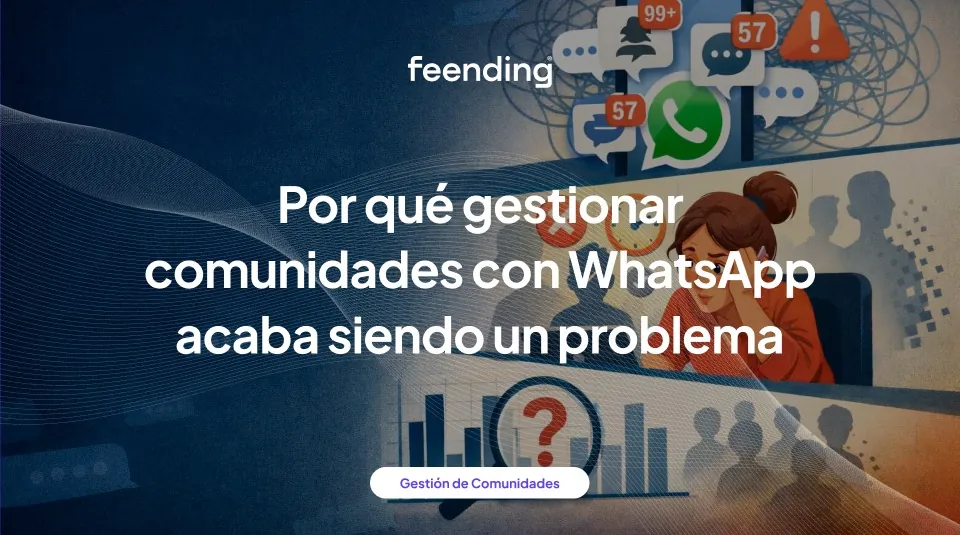
Constant noise
Messages accumulate, topics mix, and important information gets lost among irrelevant conversations.
Saturation and silent abandonment
Many members do not leave the group, but they mute it. They stop participating, and the community loses vitality without anyone noticing.
Dependence on the administrator
Everything goes through one or two people: adding members, reminding rules, reactivating conversations. If those people get tired or leave, the community suffers.
Lack of structure
There are no differentiated spaces for events, content, presentations, or networking. Everything happens in a continuous conversation.
The big problem: there is no data
This is the most critical point.
With WhatsApp:
You don't know who is really participating
You don't know what content works
You don't know what connections are generated
You can't measure engagement
You can't improve with criteria
Managing professional communities without data is doing it blindly. Everything depends on intuition and personal effort.
When WhatsApp stops being sufficient
There are clear signs that a professional community has outgrown WhatsApp:
Members stop participating actively
The conversation loses focus
Events are organized, but it is not known what impact they have
The community depends too much on specific individuals
When this happens, it is not a problem of the community. It is a problem of the tool.
What a professional community really needs
A professional community needs more than just a chat. It needs a system that allows:
Structured professional profiles
Clear spaces for content and events
Intentional networking dynamics
Member segmentation
Metrics on participation and connections
This is where alternatives to WhatsApp for professional communities come in, specifically designed to manage communities, not just to chat.
From conversation to system: the necessary leap
Platforms like Feending, a community management platform for professionals with intelligent networking and metrics-driven events, allow for that leap.
Instead of an endless conversation, the community has structure, continuity, and real data about what is happening inside.
A clear example is Impact Social Cup, a community that brings together entrepreneurs, investors, and agents of the social impact ecosystem. Before centralizing their community, communication and interactions were scattered across different channels. With Feending, they were able to unify events, information, and connections in one digital space, facilitating that professional relationships were formed intentionally rather than by chance.
WhatsApp is not the enemy, but it is not the solution
WhatsApp will continue to be a great communication tool. The problem arises when it is asked to do the work of a professional community management platform.
Managing a community is not just talking. It is connecting, structuring, measuring, and improving.
Conclusion
WhatsApp can be a starting point, but it cannot be the system on which a sustainable professional community is built.
👉 Because managing a professional community goes far beyond communication: it requires purpose, systems, and data.
Managing professional communities with WhatsApp ends up being a problem not because of the tool, but because of the expectations placed on it. When this is understood, making the leap to a specific platform stops being a technical decision and becomes a strategic decision.
![Association management software: what it should have [2026]](/assets/software-gestion-asociaciones-DujLQosD.webp)