For what type of organizations does a professional community management platform make sense?
3 min read
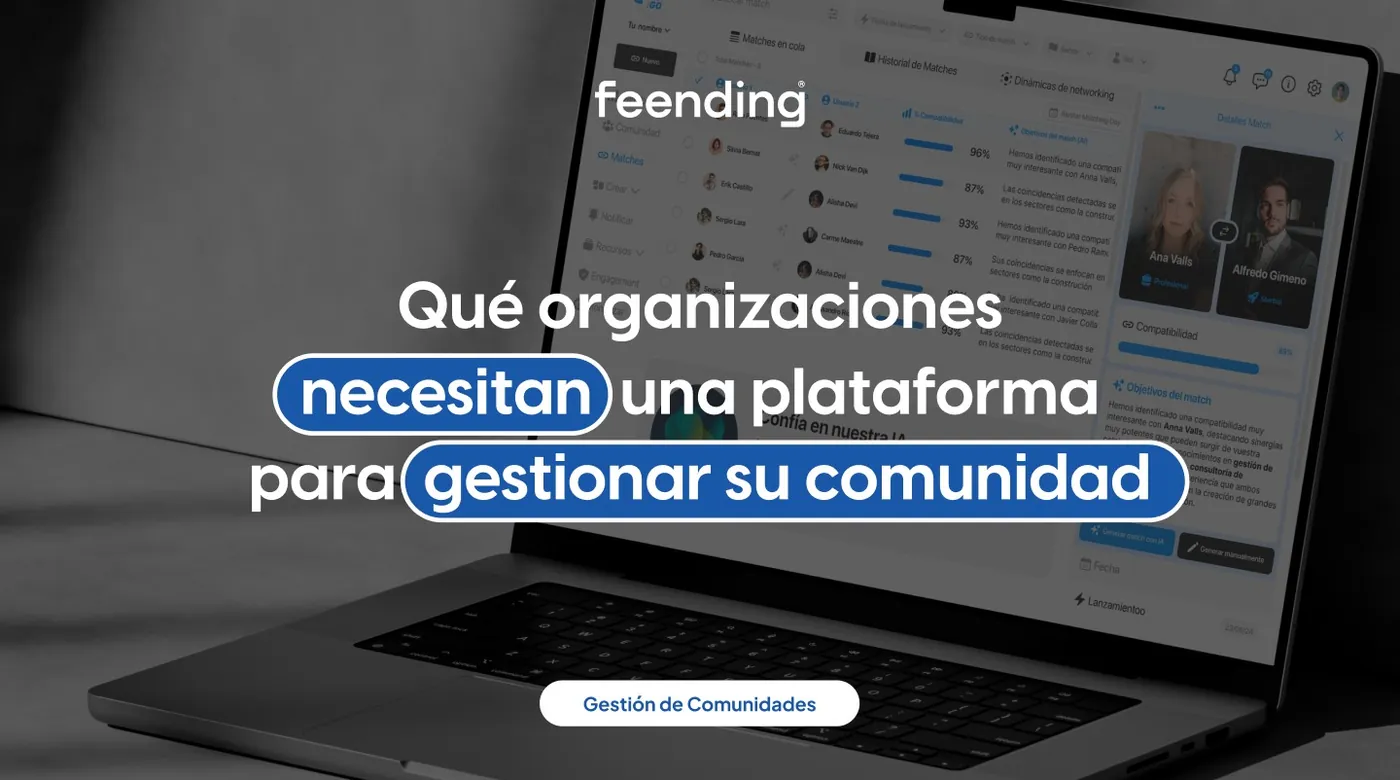
Not all communities need the same technology or the same level of structure from day one. However, when a community starts to grow, to generate real relationships, and to have an impact, the way to manage it ceases to be an operational issue and becomes a strategic decision.
At that point, the question is no longer whether to use technology, but what type of technology makes sense to support the growth of the community without oversizing the investment or losing focus.
👉 Before diving deeper, it’s important to understand what it means to manage a professional community consciously, as we explain in how to manage a professional community effectively and purposefully.
The problem is not the lack of tools, it's choosing them arbitrarily
Many organizations fall into one of these two extremes:
trying to manage complex communities with overly basic tools
or investing from the start in oversized solutions that are not used
In both cases, the result is usually the same: frustration, low usage, and a feeling that “technology doesn’t work.”
The key is not to have more functionalities, but to have technology that adapts to the real moment of the community.
Meaningful technology: growing at the pace of the community
A community does not start complex. It evolves.
That’s why the technology that accompanies it should fulfill three basic principles:
Modularity
Start with what is essential and add functionalities when the community truly needs them.Flexibility
Adapt to different types of communities, dynamics, and objectives, without imposing a single way of managing.Conscious scalability
Grow in features as the number of members, activity, and impact increase.
This approach allows technology to grow with the community, not the other way around.
Real case: Chair of Business Culture - Universitat de València
A clear example of the above is the Chair of Business Culture at the Universitat de València, which needed to reconnect and keep its community of alumni active, which until then was dispersed across different channels and becoming increasingly disconnected over time.
Before digitalizing its management, communication was irregular, ineffective, and difficult to scale. There was no unified database or a central platform from which to share information, events, or content in an organized manner.
👉 To overcome these challenges, they adopted a flexible technology like Feending, which allowed them to:
centralize communication with current and former students
create and spread events that encourage participation
organize content clearly and accessibly (including formats like podcasts)
offer a history of past activities to provide context and value to users
All of this was configured in a flexible web app, designed to grow progressively and adapt to the pace and needs of an academic institution.
The results were significant:
a community centralized in a single space
more than 100% order in managing content, events, and resources
direct contact with the Alumni community without relying on dispersed channels
greater sense of belonging among community members
According to Juanjo Torres Montesa, Director of the Chair of Business Culture at UV:
“Feending has allowed us to take the first step in centralizing communication with our Alumni community in one space. Having our own platform helps us organize content, share events, and lay the foundations for a more connected and participative community.”
This case shows how modular and adaptable technology can turn a fragmented community into a cohesive digital ecosystem, without excessive effort or premature investment.
Which organizations benefit most from this approach
Professional associations and colleges
These organizations manage communities with high relational value and clear expectations from their members. Modular technology allows starting with communication and events, and gradually incorporating impact measurement or networking as the community matures.
Hubs, ecosystems, and entrepreneurial communities
In ecosystems, the value lies in connections. Here, technology must allow activating relationships, measuring them, and improving them over time.
👉 That’s why it’s crucial to be able to measure the real impact of networking, as we develop in [LINK TO “How to measure the impact of a professional community (and why data changes everything)”].
Alumni communities
As demonstrated by the experience of the Chair of Business Culture, alumni communities often start informally, but over time require a system that allows maintaining the relationship and activating long-term opportunities.
Social organizations and foundations
Even in communities with a social purpose, technology is key to sustaining impact. Starting simply and growing in capabilities allows for professionalization without losing closeness.
👉 This balance between purpose and sustainability is analyzed in how a professional community can be economically sustainable without losing its purpose.
Adjusting investment to what really matters
One of the greatest benefits of modular technology is that it allows to adjust investment to the real impact generated by the community.
Investing well does not mean investing more, but:
prioritizing what adds value today
avoiding functionalities that are not used
incorporating new layers only when they make sense
This approach reduces risk, improves adoption, and makes technology perceived as an ally, not as a cost.
Conclusion
A management platform for professional communities makes sense when the organization understands that its community will grow and that technology must accompany that growth flexibly and consciously.
Modular, adaptable, and scalable technology allows focusing investment on what really matters: generating impact, taking care of members, and building a sustainable community over time.
That platform is 👉🏼 feending.
![Association management software: what it should have [2026]](/assets/software-gestion-asociaciones-DujLQosD.webp)