Data and metrics: KPI to measure the impact of your professional community
3 min read

Written by Borja MartosCMO & Co-Founder
Managing a professional community is much more than bringing together people with common interests. The real challenge lies in measuring its performance, understanding what works, what does not, and how to optimize interactions to achieve specific goals.
At this point, metrics and KPI’s (Key Performance Indicators) become the compass that guides strategic decisions. Our tool Feending puts in the hands of managers an intelligent software capable of collecting, analyzing, and presenting key data to continuously improve the health and impact of the community.
Why measuring is so important in a professional community
Without data, any effort in managing a community is like sailing blind. You can organize events, publish content, and foster debates, but if you do not know how your community reacts, you will be improvising. Measuring is not just about keeping track of numbers: it is about understanding member behavior, detecting trends, and making evidence-backed decisions.
In the case of professional communities, measurement has an additional value: it demonstrates the return on investment (ROI) to sponsors, partners, or the organization itself.
Platforms like ours at Feending, which integrate AI to connect communities, not only facilitate this data collection but also help interpret it in a real context.
Essential KPI’s to evaluate the impact of your community
Not all indicators are equally relevant. The key is to choose those that truly reflect the performance and evolution of your community. Some of the most important KPI’s are:
Growth rate
Measures the increase of members over a given period. A healthy community grows steadily, although the quality of members should always weigh more than the quantity. Our intelligent software Feending allows you to see this growth segmented by interests, location, or activity level.
Participation level
Counting members is not enough: what matters is knowing how many are actively interacting. Posts, comments, event attendance, or responses to surveys are clear signs of participation.
Engagement rate
This KPI measures the degree of emotional and practical connection that members have with the community. High engagement indicates that the content and activities are relevant and provide value.
Event attendance
If your community hosts in-person or virtual events, attendance and repeat participation are key metrics. Feending allows you to track these figures and compare them across different activities.
Generated networking
In professional communities, creating connections between members is a central objective. Measuring how many contacts, collaborations, or projects arise thanks to the community is fundamental to evaluating its impact.
Tools and methods for accurate measurement
A common mistake is collecting data without a clear method to analyze it. The key is to use tools that integrate automation and intelligent analysis, like Feending, which offers customized metrics for different types of communities: business hubs, educational campuses, innovation networks, etc.
Among the most effective methods, we find:
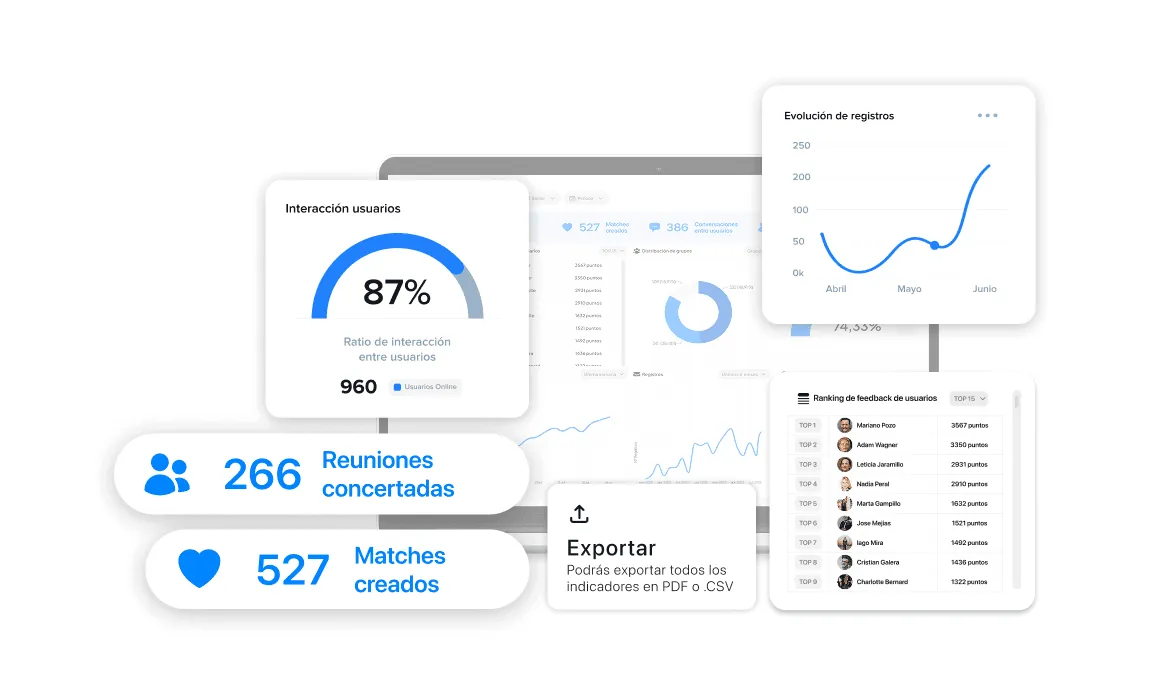
Interactive dashboards: Visualize the status of the community in real-time and the evolution of each KPI.
Segmented surveys: Allow you to know the satisfaction and needs of different groups of members.
Behavior analysis: Tracks user activity to detect patterns and foresee trends.
Automated reports: Generate reports ready to present to management or strategic partners.
The difference between measuring "manually" and doing it with intelligent software is the ability to obtain clean, updated data ready for action.
From data to action: how to interpret and act
Measuring without acting is like having a map and not moving. The true value of KPI’s lies in their interpretation and in implementing improvements. For example:
If the participation level drops, it may be time to rethink debate topics or diversify content formats.
Irregular event attendance may indicate that the dates or logistics are not convenient for members.
If engagement is high but growth is low, it may be that the recruitment strategy needs strengthening.
With Feending you can not only identify these problems but also receive data-driven suggestions to improve member experience and optimize community performance.
Qualitative metrics: what numbers do not say
Not everything is measured in exact figures. Managing a professional community also requires paying attention to qualitative metrics, those that reflect the real impact on the lives and development of its members.
The quality of interactions, for example, can be a more valuable indicator than any percentage. A community that generates success stories, relevant collaborations, or strategic alliances demonstrates a value that transcends cold data. The way it is perceived from the outside also matters, whether through recognitions, awards, or mentions in specialized media.
Even the perception of value by the members themselves, based on how they feel that the community drives their professional growth, becomes a key element for understanding its true impact. Although more subjective, these metrics provide a deep and complementary view that, combined with quantitative figures, offers a much more precise picture of the community's health and relevance.
Steps to implement an effective measurement system
If you want to start measuring the impact of your community professionally, you can follow this plan:
Define clear objectives: Before choosing KPI’s, be clear about what you want to achieve with your community.
Select relevant metrics: Not all KPI’s work for all communities; choose those that align with your strategy.
Choose the right tool: Go for an intelligent software like Feending that adapts to the size and nature of your community.
Establish a review schedule: Periodically evaluate the results to detect trends and changes.
Communicate the results: Share achievements and areas for improvement with members to maintain transparency and motivation.
Measuring the impact of a professional community is not optional: it is the foundation for making smart decisions, justifying investments, and keeping members engaged. KPI’s are the language that translates activity into results, and having a technological ally like Feending allows you to take this measurement to the next level.
In an environment where competition for attention is fierce, the difference between a community that grows and one that stagnates lies in the ability to measure, interpret, and act. And on that path, AI to connect communities has become an essential tool.