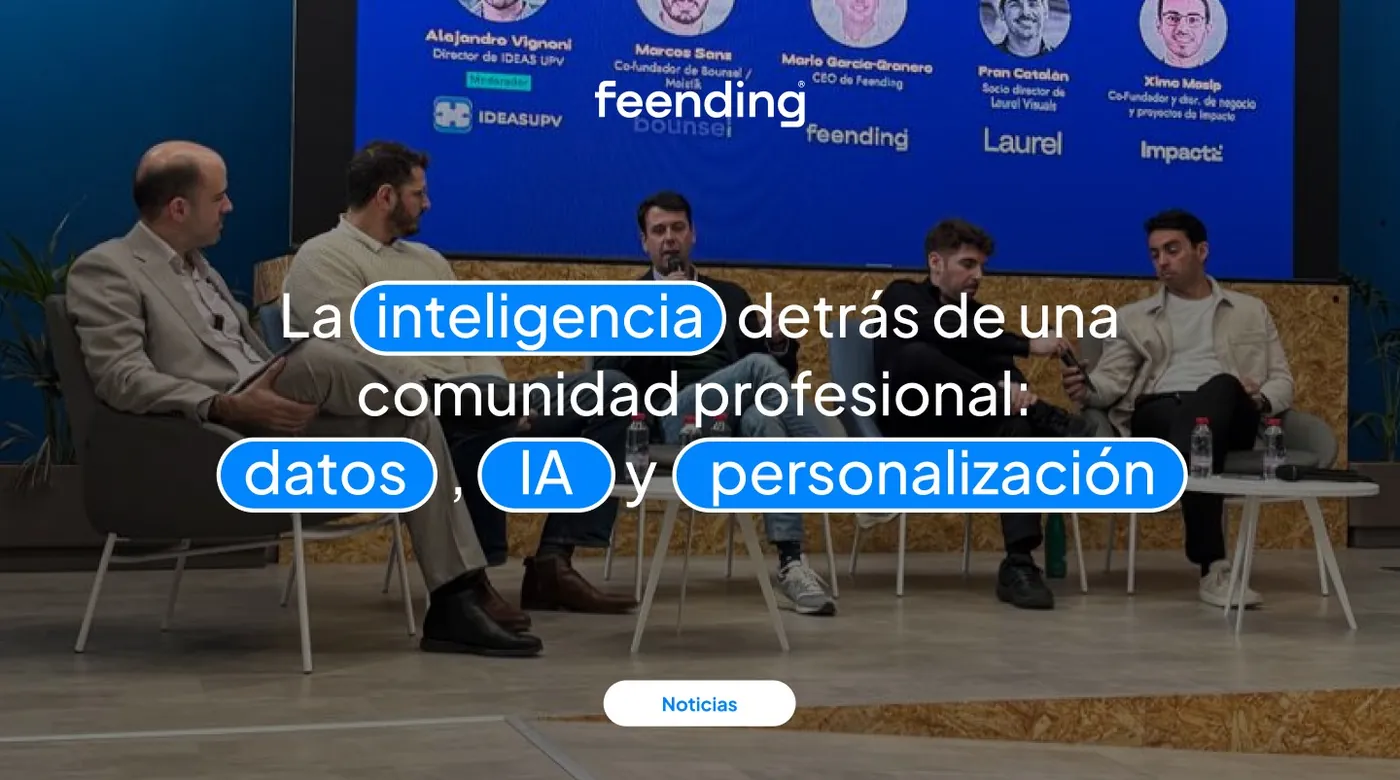
The intelligence behind a professional community: data, AI, and personalization
For a long time, professional communities have been managed intuitively. Events were organized, communications were sent, and meetings were encouraged among people with common interests.
But there was a problem:
there was a lack of information to truly understand what was happening within the community.
Who connects with whom?
What type of content generates more interest?
Which members participate the most?
What opportunities are actually being generated?
Without data, all these questions remain in the realm of intuition.
Today, technology allows us to take a further step: to turn the management of a community into an intelligent system that learns from what happens within it.
From isolated data to useful knowledge
In many organizations, there is data, but not necessarily knowledge.
Registered events.
Users in databases.
Interactions on platforms.
The problem is that isolated data provides little value.
As Mario García, CEO and co-founder of Feending, explains:
"Having loose data does not provide value; it is the correlation between them that helps to understand from the general the particular needs, and with that to provide personalized value to the clients."
The real value emerges when that data is connected to one another.
When a platform is able to relate:
professional profiles
interests
participation in events
connections generated
behaviors within the community
then something much more powerful begins to emerge: community intelligence.
Artificial intelligence applied to professional communities
At Feending, artificial intelligence is not used as a superficial layer or an isolated functionality. It is part of the core of the platform.
AI allows for analyzing behavior patterns within the community to understand:
which profiles have similar interests
which members can generate valuable connections
which content may be relevant for each user
which dynamics generate more participation
This allows transitioning from a static community to a dynamic and adaptive community.
The platform learns from the activity of users and continuously improves the experience.
A personalized experience for each member
One of the significant changes that technology introduces in professional communities is the personalization of the experience.
In traditional models, all members receive the same information.
In contrast, when there is data intelligence, the platform can offer each user:
relevant events for their profile
people to connect with
professional opportunities aligned with their interests
content that truly provides value
This turns the community into a much more relevant and useful experience for each member.
A platform that shows you what you need at every moment
Another major change introduced by the use of artificial intelligence is that the platform stops being simply a place to consult information.
It begins to act as a reactive and intelligent system.
This means the platform can help you discover:
who you should know within the community
which event might be most interesting for you
which opportunities are being generated in your professional environment
which conversations are happening and may be relevant
Instead of actively searching within the community, the platform brings you what may provide value at every moment.
Technology as a facilitator of human relationships
It is important to understand that technology does not replace people or human relationships.
On the contrary.
Technology allows those relationships to occur more easily, with more intention, and more impact.
In professional communities, the value is not in the platform itself, but in the connections generated among people.
Technology simply creates the conditions for those connections to happen more naturally and effectively.
The future of professional communities
For years, professional communities have been spaces to share experiences and generate contacts.
Today they are evolving into something much more sophisticated: intelligent ecosystems of professional relationships.
Ecosystems where:
connections are intentional
impact can be measured
the experience is personalized
and the community continuously learns from itself
Conclusion
Professional communities are entering a new stage marked by the use of data, artificial intelligence, and the personalization of experience.
In this new context, platforms like Feending not only facilitate the operational management of a community but also allow it to be understood, optimized, and evolve intelligently.
Technology stops being an administrative tool to become a engine of knowledge and high-value professional connections.
Because when data is connected, the community stops being a group of people…
and becomes a living system that learns, evolves, and generates opportunities.
![Association management software: what it should have [2026]](/assets/software-gestion-asociaciones-DujLQosD.webp)