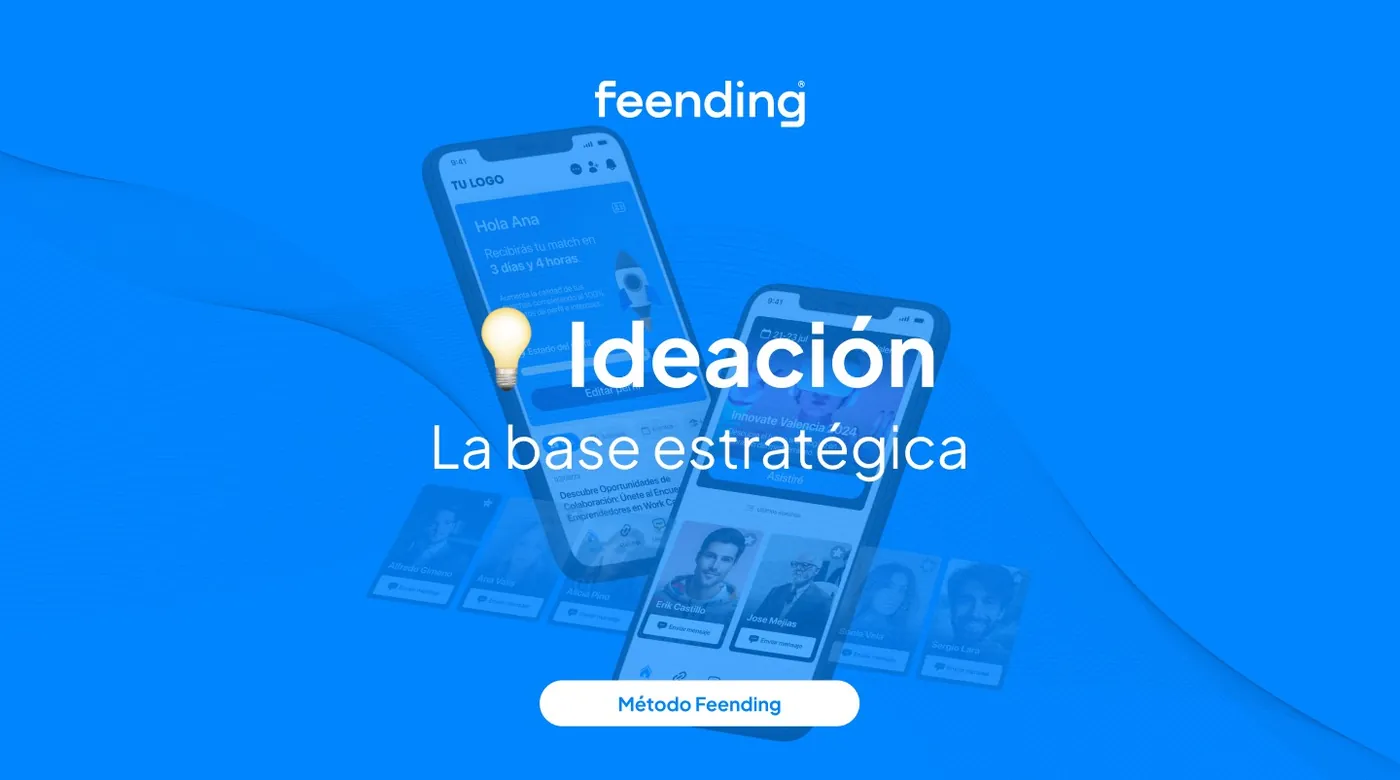
BLOCK 1: IDEATION – The strategic foundation
In a hyperconnected world, where collaborative learning, innovation, and employability increasingly depend on professional communities, improvisation is no longer an option. A community that is born aimlessly, without clear objectives or appropriate tools, risks dwindling within a few months.
That’s why the Feending method begins with a crucial step: ideation. This stage not only marks the beginning but determines the strength and impact that the community will have in the future.
What is ideation within the Feending method?
Ideation is the first strategic block of the five that structure the Feending method: Ideation, Communication, Dynamization, Monetization, and Analysis.
Its objective is to answer the great foundational questions:
Why does the community exist?
What value does it bring to its members?
What problem does it solve or what transformation does it generate?
A well-ideated community is built on a clear and shared purpose. That purpose is what will differentiate a disorganized group from a solid, digital community with identity and sustainability over time.
The Feending methodology proposes to work on ideation from five essential pillars:
1. Define the value proposition
The key question here is: what does someone gain by joining?
It can be access to knowledge, networking opportunities, employability, mentoring, support, or inspiration. What is important is that the proposal is clear, relevant, and differentiated.
2. Establish clear objectives
Without defined objectives, the community loses direction.
Are you looking to foster collaboration among professionals? Propel innovation projects? Create a support space for a specific sector? Setting measurable goals will allow you to evaluate the impact and maintain collective motivation.
3. Design the internal structure
In this stage, strategic decisions are made:
Open or closed community.
Defined roles (administrators, moderators, mentors…).
Participation dynamics and the type of content to share.
A community organized from the outset facilitates cohesion and avoids unnecessary friction.
4. Build the visual and communicative identity
Communities don’t just function based on what they offer but also on how their members feel about being part of them.
A strong name, a representative logo, a coherent color palette, and a tone of voice aligned with the purpose reinforce the sense of belonging and consolidate identity.
5. Choose the right technology
This is where Feending comes into play.
Many communities continue to operate on scattered channels: emails, WhatsApp groups, isolated documents. This leads to communication failures, loss of information, lack of follow-up, and reduced impact.
With Feending, managers have an all-in-one intelligent software to plan, communicate, dynamize, and analyze the community in one place. This not only saves time but also allows for a global view of the generated value and strategic management supported by Artificial Intelligence.
Why does ideation make a difference?
Because it establishes coherence and purpose from the beginning.
When a community is born well-defined:
✅ Its members clearly understand what it offers them.
✅ The leaders know where to direct efforts.
✅ The technology enhances interaction and impact.
On the other hand, when starting "improvised," there is too much reliance on the initial enthusiasm of a few, which generates wear and disorganization in the medium term.
Conclusion:
Ideation is much more than a first step: it is the strategic foundation upon which everything else is built.
With the Feending method and its technological platform, communities can be born with clarity, grow with purpose, and evolve sustainably.
In a context where human and professional connection is more valuable than ever, ideation is the starting point that ensures a community is efficient, connected, and committed from day one.
Want to know more? Contact us!
This block is developed in full in the Academy: Ideation: why your community exists and what a member gains.