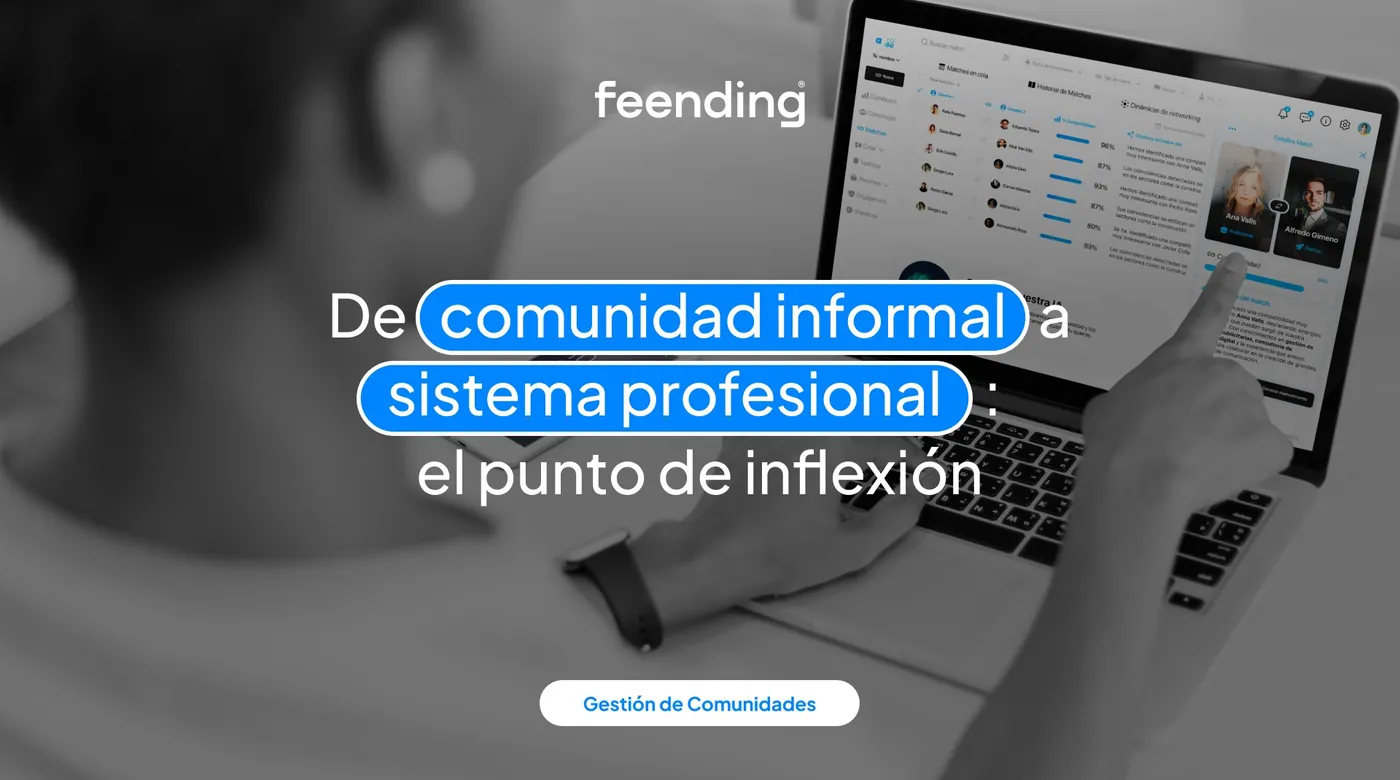
Twenty years ago, many sales teams operated very similarly to how many professional communities operate today. The relationship with clients depended almost entirely on specific individuals, information was scattered, and control was limited. Each salesperson had "their agenda", "their contacts", and "their way of doing things".
For a time, that model worked.
But only while the team was small and the volume manageable.
As soon as the business grew, problems arose: loss of information, excessive dependence on key individuals, difficulty scaling, and lack of real visibility into what was happening.
Until the CRM arrived.
It wasn't just the adoption of a new tool. It was a mindset shift: moving from a management style based on memory, intuition, and individual effort to a shared system with data, clear processes, and a global vision.
Today, professional communities are exactly at that same level of maturity.
👉 This parallel directly connects to what we explain in how to effectively and purposefully manage a professional community.
Before the CRM: sales without a system
Before the widespread adoption of CRMs, commercial management had a very clear set of characteristics:
contacts lived in notebooks, personal diaries, or Excel
follow-up depended exclusively on the salesperson
there were no reliable and centralized data
scaling the team was chaotic
Companies had no real control over their pipeline or their relationships with clients. When a salesperson left, they took with them information, context, and relationships. The company grew, but it did so on a fragile foundation.
Everything worked… until it stopped working.
The CRM not only organized information. It allowed for the professionalization of commercial management, reduced dependency on specific individuals, and enabled decision-making based on real data.
Today: professional communities in the same scenario
Many professional communities today function exactly like those pre-CRM sales:
information is spread across WhatsApp, Mailchimp, Excel, or Eventbrite
participation depends on a small core of individuals
the real impact of actions is not measured
the continuity of the community is fragile
Management often relies on goodwill, personal effort, and improvisation. While the community is small, the model holds up. But as it grows, complexity increases and frictions, wear, and loss of focus begin to emerge.
👉 We analyze this operational chaos in detail in the hidden cost of managing a community with loose tools.
The problem is not the lack of interest or people.
The problem is the lack of a system.
Digitalization as a turning point
Just as CRM allowed sales teams to:
centralize all information in a single system
professionalize processes
work with reliable data
scale without losing control
today community management software allows for exactly the same with professional communities.
Digitalizing a community does not mean "adding technology for the sake of it". It means creating a solid foundation on which the community can grow with order, purpose, and continuity.
Platforms like Feending act as that "community CRM": software designed specifically to centralize members, communication, events, relationships, and interactions in a single system intended for professional communities.
This allows for a shift from reactive management to conscious management, where decisions are made with information and not just with intuition.
From voluntarism to system
One of the greatest parallels with the commercial world is this:
just as sales could not continue to depend on the "good salesperson", communities cannot forever depend on the "good manager".
Software does not replace strategy or purpose, but it makes them scalable.
Without a system, everything depends on individuals.
With a system, value is distributed and sustained over time.
Conclusion
Professional communities are experiencing today the same moment that sales experienced two decades ago. Digitalizing is no longer a trend or an extra: it is a necessity to grow with purpose, data, and control.
Organizations that understand this turning point will be able to transform their communities into strategic, measurable, and sustainable assets. Those that do not will continue to rely on individual effort, with the risk that implies in the medium and long term.
Feending is born precisely to accompany organizations in this leap, just as CRMs accompanied the professionalization of sales. As community management software, it allows for centralizing operations, working with real data, and scaling communities without losing their essence or purpose.
Because when a community stops being managed informally and starts relying on a system, it stops surviving… and begins to truly grow.
![Software for startup accelerators: what it should have [2026]](/assets/software-aceleradoras-startups-BYc6vc6m.webp)
![How to manage an association's members without relying on Excel [2026]](/assets/gestionar-socios-asociacion-sin-excel-D-Xi_bRB.webp)