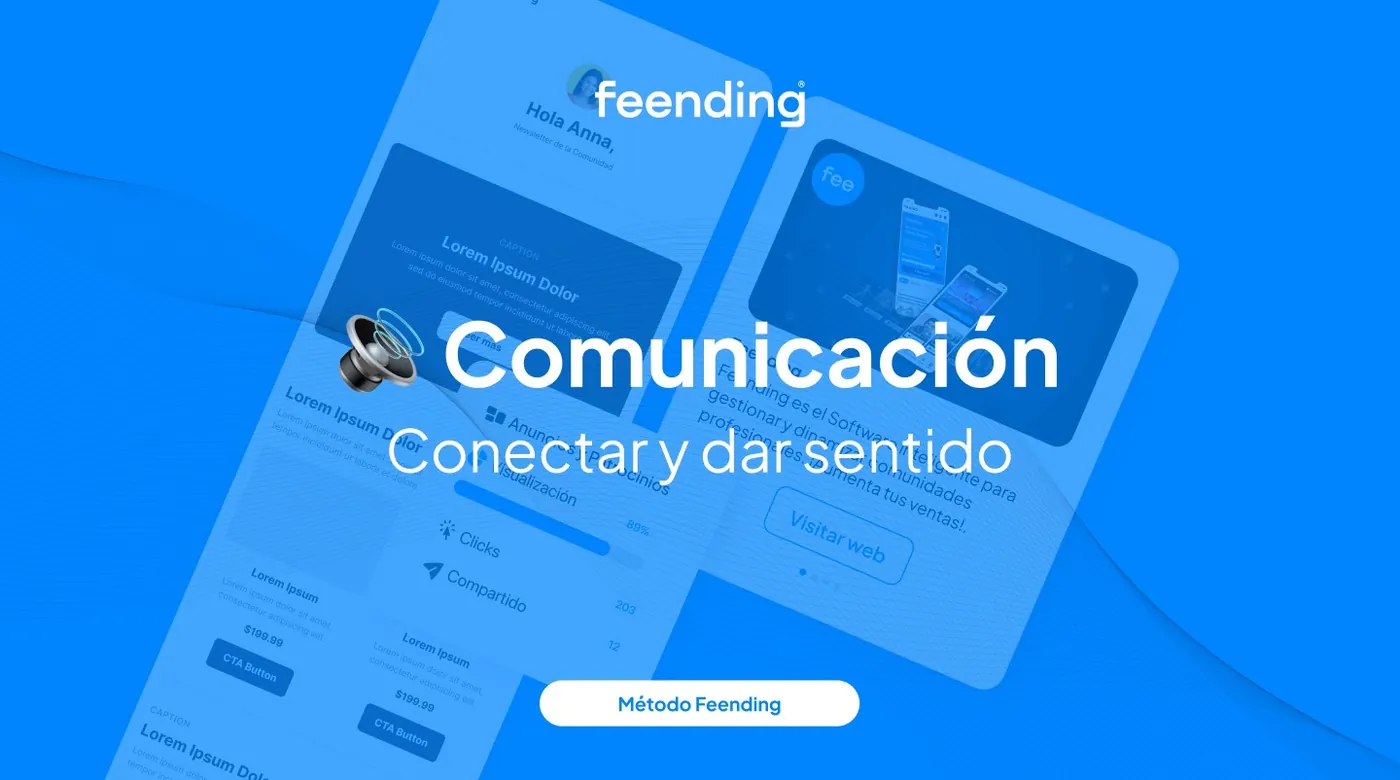
Block 2: COMMUNICATION – Connect and make meaning
3 min read

Written by Borja MartosCMO & Co-Founder
A community doesn’t start when someone signs up; it starts much earlier.
In a digital environment saturated with touchpoints, invitations, and platforms, communication is the factor that determines whether a person understands the value of belonging to the community… or ignores it. That is why, within the Feending method, communication is not an add-on: it is a key strategic block that connects ideation with real participation.
A well-designed community, but poorly communicated, is doomed to have low conversion, little engagement, and disoriented members.
What is communication within the Feending method?
Communication is the second block of the method, and its main function is to convey value to the community before and after registration.
It is not just about informing, but about constantly answering three fundamental questions for any member:
What is this community?
What is the benefit of being here?
How should it be used and how should people act?
The objective is clear: improve the conversion rate, facilitate initial activation, and lay the foundations for conscious participation aligned with the purpose defined during ideation.
Communication starts before registration
One of the biggest mistakes in community management is assuming that explanation begins “once inside.” In reality, the most important communication happens before someone decides to join.
When you invite someone to your community, you must explain clearly and attractively:
What the community is (not the tool, but your community as a concept)
What its value proposition is
What real benefits they will obtain
How they will obtain them (this is where the Feending digital tool appears)
The Feending method proposes several key resources to achieve this:
A simple and straightforward explanatory video
A welcome document summarizing the purpose
An interactive onboarding process
In-person training or via webinar
These elements not only inform, but also build trust and reduce entry friction, increasing the probability that the user becomes active from the very beginning..
Communicating once inside: clarity and coherence
Communication work does not end with registration. In fact, that is where the most important part begins.
Once inside the community, it is essential to keep communicating consistently the what, the why and the how of the community. This avoids the feeling of an “empty platform” and helps members understand how to participate and what is expected of them.
The Feending method places special emphasis on three pillars:
1. Smart use of communication channels
Not all communication should go through the same channel. Feending structures communication so that it is clear and non-invasive:
Mailing: structured and targeted communication
Newsletter: Highlighted information.
Wall: visible posts for the entire community
Chat: direct or group messages
This differentiation avoids saturation and improves the quality of interaction.
2. Communication segmentation
Sending “everything to everyone” is one of the biggest mistakes in digital communities.
Segmenting by interests, roles, or activity level makes it possible to send the right message to the right person. This improves response rates, increases content relevance, and reinforces the feeling of a personalized experience.
3. User training
The better members understand how the platform works and what they can do in it, the higher their participation level.
That is why the Feending method recommends offering content, sessions, or webinars that explain how to use the community and its tools. Training is not a waste of time: it is a direct investment in engagement.
Why does communication make the difference?
Because it turns a good idea into an understandable and actionable experience. When communication is clear and strategic:
✅ Users quickly understand the value of the community
✅ Initial participation increases
✅ Early disengagement is reduced
✅ A relationship of trust is built from the start
On the other hand, when communication is confusing or nonexistent, even the best-ideated communities lose traction and relevance.
Conclusion
Communication is not just about transmitting information: it is about conveying value.
Within the Feending method, this block acts as a bridge between intention and action, between purpose and real participation. A community that communicates well does not need to constantly push its members: it supports them, guides them, and gives them clear reasons to stay.
Because when people understand why they are in a community, they truly begin to be part of it.
This block is developed in full in the Academy: Communication: conveying the value before and after sign-up.
![Alumni network: what it is and how to build yours [2026]](/assets/red-alumni-que-es-como-crearla-BsL-bTqn.webp)