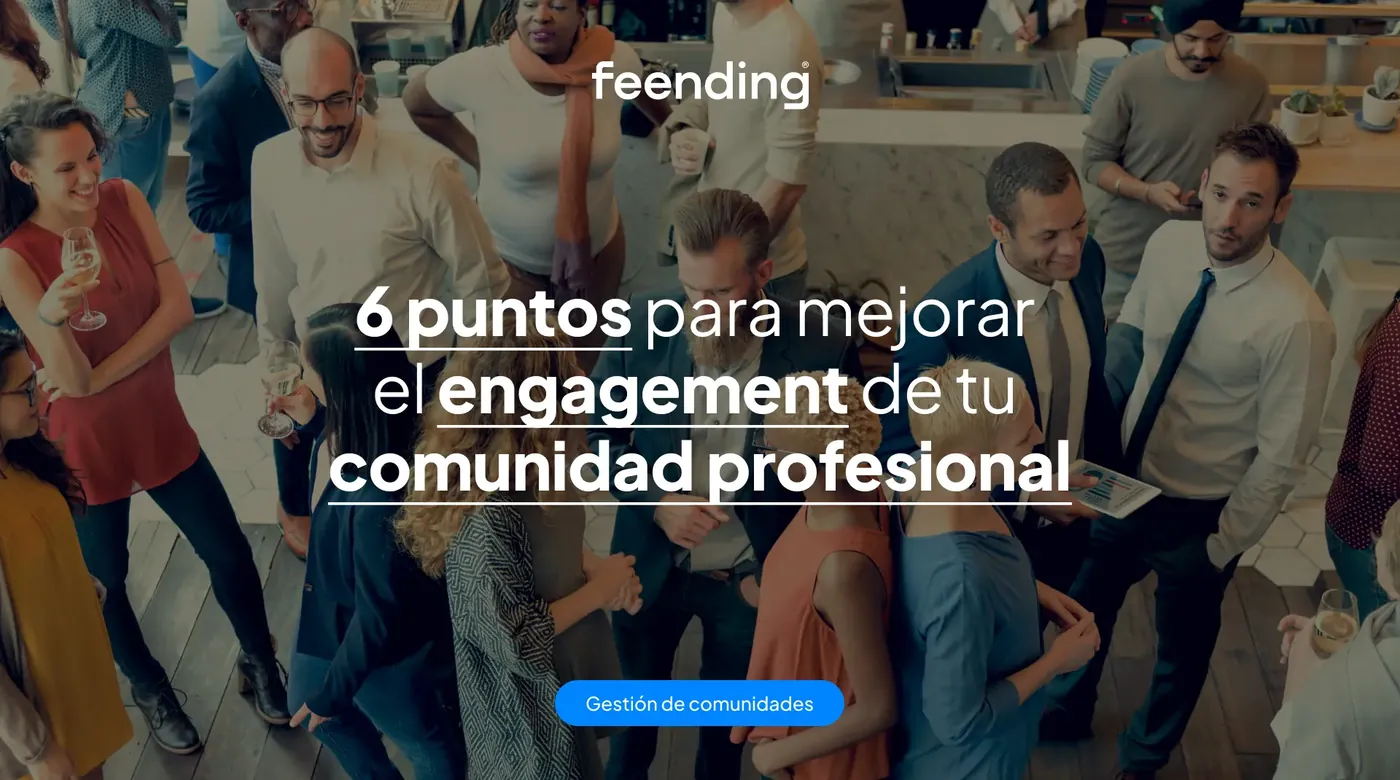
6 points to improve your community's engagement
5 min read

Written by Borja MartosCMO & Co-Founder
The engagement of a professional community is not improvised: it is designed.
Discover the 6 key points to increase the real participation of your members, with data, strategy, and the right technology.
There are communities with hundreds of members that barely generate activity. Events with good attendance but no continuity. Communication groups where the same people always participate. Members who sign up enthusiastically and disappear after a few weeks.
And there are smaller communities where members participate consistently, connect with each other, provide value, and recommend the community to others.
The difference is not in size. It is not in the budget. And it is not in luck either.
It lies in how engagement is managed.
The engagement of a professional community is the level of active and continued participation of its members. It is not measured only by attendance at events or email opens, but by the quality of interactions, the connections that are generated, and the willingness of members to continue being part of something.
Improving engagement is not a matter of communicating more. It is a matter of better designing the experience of the members from within. These are the six points that make the difference between a community that survives and one that truly grows.
1. Define precisely what each member receives for participating
The first engagement mistake is not in communication or programming tools. It is earlier: in not being clear about what value a member receives for being part of the community.
When members do not understand what they can get, they do not participate. Not because they do not want to, but because no one has explained it to them in a concrete and credible way. A professional community cannot compete for the attention of its members with a vague message about "connection and knowledge." It needs a specific and tangible value proposition.
What kind of professional connections are generated within? What knowledge is shared and in what format? What specific opportunities have arisen for other members? What changes in the professional path of someone who is part of this community?
Answering these questions with real examples is the foundation upon which engagement is built. Communities such as UCAM Alumni or Impact Social Cup have worked on this value proposition specifically for each type of member, which has allowed them to maintain a much more consistent participation over time.
Before working on any engagement tactic, ask yourself this question: can a new member understand in less than two minutes what being in your community brings to them?
👉 If you are still defining that purpose, we recommend reading [How to manage a professional community effectively and with purpose].
2. Segment before communicating
One of the main causes of low engagement is mass and undifferentiated communication. When everyone receives the same message, no one feels that message is for them. And when a message is not for you, you ignore it.
Segmentation is not an advanced technique reserved for large organizations. It is the difference between talking to a person and talking to a list.
Segmenting means understanding that a newly graduated alumni has different needs than one with fifteen years of experience. That an active partner of an association needs a different stimulus than one who has not participated for two years. That an entrepreneur within an innovation hub responds to different contents than a manager of an established company.
When communication is relevant to the recipient, engagement rises naturally. Not because you have sent more messages, but because you have sent the right message to the right person at the right time.
Platforms like Feending allow you to segment the member base by professional profile, interests, activity level, and behavior within the community, making it easier for each communication to generate real impact instead of noise.
3. Design continuous touchpoints, not just events
Many professional communities concentrate all their engagement on events. The day of the meeting there is activity, energy, and participation. But between one event and the next, the community disappears. Members do not interact, do not connect, and the bond with the community weakens week by week.
This model generates a total dependency on offline moments. A community that only exists on the day of the event is not really a community: it is an events schedule.
Communities with sustained engagement design what happens between events with the same attention they dedicate to the events themselves. Regular touchpoints that keep the relationship alive: useful and specific content for a segment of members, a networking dynamic that connects two people with common interests, the public recognition of a member's achievement, a question that invites conversation within the platform.
You do not need to generate a lot. You need to generate the right thing for the right people at the right time. When members feel that the community is present in their daily lives, even if in a discreet way, the bond is strengthened and participation in the big moments increases.
4. Measure what really matters
You cannot improve your community's engagement if you do not know what is happening inside it. And managing without data is like doing it blindly: making decisions based on feelings, repeating what seems to work without knowing why, and not understanding what is failing.
The usual mistake is to measure only the superficial aspects: total number of members, event attendance, open rate of emails. This data is useful as general indicators, but they say very little about real engagement.
What matters to measure in a professional community:
Active participation
Not how many members you have, but how many participate in a real way. Who has interacted in the last month, who has been without activity for weeks, and what is the trend over time.
Quality of connections
How many connections have been generated between members, which profiles relate to each other, and if those connections have continuity beyond the initial moment.
Response to contents and dynamics
What kind of content generates the most interaction, which formats work best, and what dynamics activate the least active members.
Evolution of engagement
How participation changes over time, if there are moments of decline, and what actions have generated activity peaks.
When you have this data, you can make informed decisions: reinforce what works, eliminate what does not generate impact, and continuously adapt your value proposition to what members really need.
👉 If you want to dive deeper into how to measure the impact of your community with real data, read [How to measure the impact of a professional community and why data changes everything].
5. Reduce friction to participate
There is a type of problem that silently kills engagement: friction. Small invisible barriers that make participating cost more than it should.
A complicated registration process that discourages before starting. A platform that does not work well on mobile. Scattered information in different channels that forces you to search for what should be handy. Events difficult to find or confirm attendance. Networking that depends on someone introducing you to another person at the precise moment.
Each of these points, separately, seems minor. But their cumulative effect on engagement is very significant. Every friction is a reason not to participate. And when not participating is easier than participating, most members choose not to.
Reducing friction means designing an experience where members find what they are looking for effortlessly: their updated profile, upcoming events, relevant content for their profile, connections that might interest them. All in a single, accessible, and smooth space.
When the barrier to participate drops, engagement climbs proportionally. Not because you have changed the value proposition, but because you have eliminated the obstacles that prevented that proposition from arriving.
6. Stop managing your community with five different tools
This is the problem that most limits engagement in professional communities and that few organizations name out loud, because it has become so normalized that it no longer seems like a problem. It is simply "how things are done."
Managing a moderately organized community ultimately requires, unintentionally, five or six different tools that are not designed to work together:
A CRM or Excel to maintain the list of members, their data, and their history
Eventbrite or another platform to manage events, registrations, and attendance
A billing tool to collect fees, memberships, or registrations
WhatsApp Groups for day-to-day communication between members
Mailchimp or another email tool for mass communications and newsletters
The result is a system broken by definition. The data of the same member is spread over four different platforms. To know if someone has attended the last three events, paid their annual fee, and opened the latest emails, three different tools must be reviewed. Every time a new member joins, they have to be registered manually in all of them.
This operational chaos not only consumes the management team's time and energy. It has a direct and measurable impact on engagement: when management is fragmented, the member's experience is also fragmented. Communications that do not arrive at the right time because the data is not synchronized. Poorly communicated events because the events platform does not connect with the member database. Networking that does not happen because there is no system that facilitates it.
A professional community management software like Feending solves exactly this. It is not just another tool to add to the list: it is the platform that centralizes everything in a single system — members, events, fees, communication, and networking — eliminating the need to maintain multiple tools connected manually.
Just as sales teams stopped managing clients in Excel when CRM appeared, professional communities are leaving behind generic tools to build on software specifically designed for them. The time previously spent synchronizing platforms becomes time to design better experiences. And that is what truly improves engagement.
👉 If you want to better understand what community management software is and what it is really used for, read [What is professional community management software and what is it used for].
Engagement is not a target. It is a consequence.
Improving the engagement of a professional community is not achieved with more messages, more events, or more individual effort. It is built when members perceive that participating is worth it, when management is organized, and when technology accompanies instead of hindering.
Clear purpose, segmented communication, continuous presence between events, data for decision making, frictionless experience, and a centralized system that sustains everything. These are the six elements that transform a community with members into a truly active community.
Want to see how Feending helps improve professional community engagement?
CONTACT US 👉🏼 https://www.feending.com/contacto
-
Frequently Asked Questions on Engagement in Professional Communities
What is engagement in a professional community?
Engagement in a professional community is the level of active and continued participation of its members: their interaction with contents, attendance at events, connections generated with other members, and readiness to provide value to the ecosystem. It is not measured only by the number of members, but by the quality and frequency of their real participation.
Why does engagement drop in professional communities?
The most common causes are the lack of a clear value proposition, mass and undifferentiated communication, the absence of activity between events, the friction to participate, and the use of generic tools that are not designed to manage communities. In most cases, the problem is not the community but the system that sustains it.
How is the engagement of a professional community measured?
Beyond event attendance or email openings, real engagement is measured by the active participation of members, the connections generated, the response to content and dynamics, and the evolution of these indicators over time. Platforms like Feending allow visualizing this data automatically and continuously.
What tools improve the engagement of a professional community?
A professional community management software like Feending, which centralizes members, events, communication, and networking in a single system, eliminates operational friction and allows managing engagement with real data. Unlike generic tools like WhatsApp, Mailchimp, or Eventbrite, it is designed specifically for the needs of a professional community.
How long does it take for a community's engagement to improve?
It depends on the starting point, but communities that work on segmentation, design regular touchpoints, reduce friction, and centralize their management in a single system usually see improvements in the first weeks. Sustained engagement is built in months, not days, but the first results are visible quickly when the changes are structural.
What is the difference between activity and engagement in a community?
Activity is what happens within a community: messages, attendance, occasional interactions. Engagement is the bond that makes a member want to keep participating, provide value, and recommend the community to others. There can be a lot of activity without real engagement, especially in communities managed with mass communication tools.